

406.587.4531
simmental@simmgene.com
406.587.4531
simmental@simmgene.com
What the Docility Evaluation Updates Mean for You
by Dr. Elizabeth Dressler, ASA Lead Geneticist
As part of an ongoing series of updates to the genetic evaluation, updates to the Docility evaluation will be implemented into production beginning the week of April 13, 2026.
Why does Docility matter?
Cattle operations are often a family business involving multiple generations, from children being raised to take over the ranch, to aging grandparents passing down their ranching wisdom. For that reason, safety and reducing handler risk is of the utmost importance. No one wants to be run up the side of a fence while handling their cattle. Docile cattle often lead to more efficient handling by reducing stress and working through facilities with fewer issues.
Docility isn’t just a learned behavior or temperament. Docility is a measurable trait, and is heritable (h2= 0.23), which means it can be improved through genetic selection.
What changed in the Docility genetic evaluation?
The International Genetic Solutions (IGS) genetic evaluation has been undergoing a series of updates over the past couple of years. The updates are being implemented for each group of traits one at a time. These updates have allowed the IGS genetic evaluation to run efficiently and maintain a weekly return of EPD. These updates can be thought of as the routine maintenance necessary to keep the genetic evaluation running most effectively, just like an oil change is necessary maintenance to keep your vehicle running.
The updates are the same as those that were applied to the previously updated evaluations including carcass weight/ribeye area, growth (weight traits), and calving ease.
-
Breed by decade interaction effect: In genetic evaluations, other variables are included in the model as effects, which helps further break down the differences in phenotype (docility). Previously, breed and decade were fit as an interaction effect meaning those variables were grouped together (e.g., Simmental x 1970). Some of those combinations of effects did not have many animals representing them, which was causing the evaluation to solve slower. They are now fit as two separate effects: one for breed and one for decade (e.g., Simmental is a breed effect and 1970 is a separate decade effect).
-
External EPD incorporation: External EPD are any EPD reported to IGS that was calculated by an entity outside of IGS. The statistical methodology for how those external EPD get incorporated in the IGS evaluation has been updated, allowing the impact an external EPD has on an animal’s IGS EPD to be more easily assessed.
The average change across the entire Simmental database was +0.52, or an increase of about half a Docility EPD unit. As seen in Figure 1 below, the majority (68.1%) of animals changed by less than one Docility EPD unit (in either a positive or negative direction).
Figure 1. Percentage distribution of Simmental population by absolute DOC change. Categories represent absolute change (magnitude, not direction).
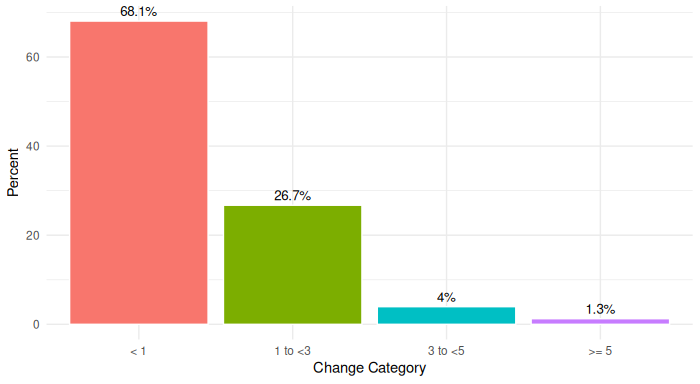
In general, members should see minimal re-ranking of animals’ DOC EPD. As always, members are advised to use the most current percentile ranking tables, which are available on Herdbook.org.
Why should I report Docility phenotypes?
Phenotypes are the backbone of genetic evaluations. The data that members report is crucial to the ability of IGS to return reliable EPD results. Although more cattle producers have expressed interest in Docility in recent years, Docility still remains a relatively lowly reported trait. Recording and reporting Docility phenotypes will provide you with more accurate Docility EPD for your animals.
To record a Docility phenotype, assign each animal a chute score (1–6 scale). Docility can be assessed at weaning or yearling, but the entire age group of cattle should be scored at the same time and by the same person. Scoring consistency is key to measuring a trait like Docility.
|
Docility Score |
Description |
|
1 |
Docile. Mild disposition. Gentle and easily handled. Undisturbed, settled, somewhat dull. Stands and moves slowly during processing. Does not pull on the headgate when in a chute. Exits the chute calmly. |
|
2 |
Restless. Quieter than average, but may be stubborn during processing. May try to back out of the chute or pull back on the headgate. Some flicking of the tail. Exits chute promptly. |
|
3 |
Nervous. Typical temperament. Is manageable, but nervous and impatient. A moderate amount of struggling, movement, and tail flicking. Repeated pushing and pulling on the headgate. Exits chute briskly. |
|
4 |
Flighty (Wild). Jumpy and out of control; quivers and struggles violently. May bellow and froth at the mouth. Continuous tail flicking. Defecates and urinates during processing. Frantically runs the fence line and may jump when penned individually. Exhibits long flight distance and exits the chute wildly. |
|
5 |
Aggressive. May be similar to score 4, but with added aggressive behavior, fearfulness, extreme agitation, and continuous movement, which may include jumping and bellowing while in a chute. Exits the chute frantically and may exhibit attack behavior when handled alone. |
|
6 |
Very Aggressive. Extremely aggressive temperament. Thrashes about or attacks wildly when confined in small, tight places. |
Key Takeaways
-
Producers are increasingly recognizing the importance of Docility in managing cattle.
-
Updates to the Docility evaluation are necessary to keep it running as efficiently as possible.
-
Members may see changes in Docility EPD, but animals will generally rank similarly to how they did prior to the update.
-
Phenotypes reported by members are the foundation of IGS’s ability to provide accurate genetic selection tools.
-
Members should consider collecting Docility phenotypes on all calves at weaning or yearling.
Members who have questions about the updates and/or specific animals are welcome to reach out to Dr. Elizabeth Dressler, ASA Lead Geneticist.
Subscribe to eNews ASA's weekly newsletter.
Sales Call: Calendar of upcoming sales and
eBlast: Sales and other industry promotions